CRM & Loyalty
Stop Defending Your Loyalty Program. Start Proving It.


I spent an hour with Loyalty360 recently for one of their Loyalty University sessions, and I wanted to put some of it down here. I sum up a conversation most loyalty and CRM professionals are already having with themselves, just quietly.
Here's what I've noticed in 20+ years of doing this: Almost everyone running a loyalty program already knows that it works, because you can feel it in the repeat visits and in the customers who keep showing up even when they have every reason not to. But knowing that it works and being able to prove that it works are two very different jobs, and most of us end up spending far more time on the first one, defending the program, than we ever do on the second.
So why does that happen? In my experience it's almost always because a corner got cut somewhere along the way, and not out of laziness, and almost never because someone didn't care. A campaign had to go out the door, or a launch had a date attached to it, and measurement quietly turned into something we'd figure out later. I've walked into a lot of client situations where later had finally arrived, the budget meeting was already on the calendar, and there simply wasn't an answer to give. The program had been working the whole time. Nobody had set it up to prove that it was.
That's really the whole thing in a single sentence: the program didn't fail, the foundation to prove its worth was just the piece that got skipped.
Build it to learn, not to send
A lot of programs quietly turn into machines that only send things out, where the goal becomes getting the campaign delivered, hitting this week's number, and making sure it looks good creatively. Nobody ever decides that on purpose and it isn't a knock on anyone. It's just what tends to happen when there's no muscle built into the program for learning from what's actually going on inside it.
The framing I use with clients is that your program should be a laboratory rather than a lever. A lever only pulls, and in most cases it pulls toward a discount, while a laboratory tells you when pulling that lever is the right move and when it isn't. You still get to send offers, you just get to be right about who receives them and when.
Speed is something you build
People tend to talk about speed as though it were a personality trait, as if some teams are simply faster than others. I don't buy into that theory. Speed is infrastructure. If you have test and control set up correctly, naming conventions that hold up over time, and a clean line running from your program activity back to sales, then you can move quickly because you planned to move quickly. If you don't have those things in place, no amount of hustle is going to make up the difference, and you end up routing a single email through four rounds of approval over two weeks.
We also lean on AI wherever it genuinely accelerates the work, and we're an AI-forward agency, but there is always a person reviewing the output before it matters. The moment you skip that oversight at the exact points where you're trying to build proof, you put the entire reason you're doing this at risk.
Segmentation that actually separates value
If your goal is to prove your program's worth, the first thing to stop doing is treating your entire subscriber list as one loyal audience. Anywhere from 10-20% are likely considered loyal, and only 5-10% would be considered "champions" of your brand. (A "champion" being a customer that frequents and spends the most, and likely needs no incentive to use your product or service.)
Your dormant and lapsed customers still matter, but they aren't where you're going to make your case. Your active, casual customers are your largest group, and they're also your best source for finding people who resemble your top customers. Your actual top customers are the smallest slice of the file, and that's where the real leverage sits, because a 5% lift among that group does something meaningful to the bottom line in a way that the same lift somewhere else simply doesn't.
From there, it's worth pushing past the obvious signals. Everyone has subscribes, purchases, and comebacks, but the more interesting information usually sits a layer deeper, in what someone actually buys, what time of day they buy it, and the small bits of texture that tell you who your real champions are so that you can go find more people like them.
It has to connect to sales
You can talk about your open rates and your beautiful creative all day long, but if you can't connect any of it back to dollars, you're going to lose the budget fight, and that's just how it goes. So the mindset I try to instill in clients isn't "how do I defend this program," it's "how do I prove this program."
The proof: a national fast casual brand
We worked with a national fast casual brand that needed six figures in incremental sales inside a single month, which was a number that honestly felt out of this world when we first heard it. They had a small team, participation in the program was low, and the program itself hadn't been built to learn anything.
We spent the first two months doing nothing but testing offers, messaging, and segments they hadn't even considered, and then it scaled. Participation went up, sales followed, and the part nobody expected was that it held after the campaign ended. When the lift eventually did start to dip, we reran it and it came right back.
That's what a program built to prove itself looks like in motion.
This works at any size
I hear the same three objections constantly, which are that the audience is too big, that it's too small, or that customers don't engage enough. None of those things change the need for the structure underneath, they only change the shape it takes. If your audience is small, run fewer and bigger tests. If your program is new, build the data model before you launch rather than after. If engagement is low, start with something modest like tracking who's adding to cart, and build out from there. You genuinely don't need five million people in order to start proving something real.
Ten questions to take back to your team
I closed the session with ten questions, two each across five areas: Build, Speed, Aim, Sales, and Compound. Here they are.
Build
- Could two people on your team build the exact same audience from the exact same brief?
- On your next campaign, will test and control be defined before the creative is?
Speed
- Could you pull last quarter's lift today, without asking anyone for it?
- How many approvals does one email need, and how many of them actually change anything?
Aim
- Can you name your top 10% of customers and say what separates them from everyone else?
- When was the last time you retired a segment instead of adding one?
Sales
- Can you tie last month's program activity to a dollar figure your CFO would accept?
- Do you know what a member is worth versus a non-member, accounting for the fact that your better customers were always going to join anyway?
Compound
- When a test wins, is there an actual plan to scale it, or does it just end?
- Could someone on your team find the results of a test you ran a year ago?
Every "no" on that list is probably a corner that got cut somewhere, and that isn't a judgment on anyone. It's just useful information.
Passion is what got most of us into this work in the first place, but passion doesn't run a budget meeting and proof does. If you build your program to prove itself from day one, you'll spend a lot less time defending it and a lot more time growing it.
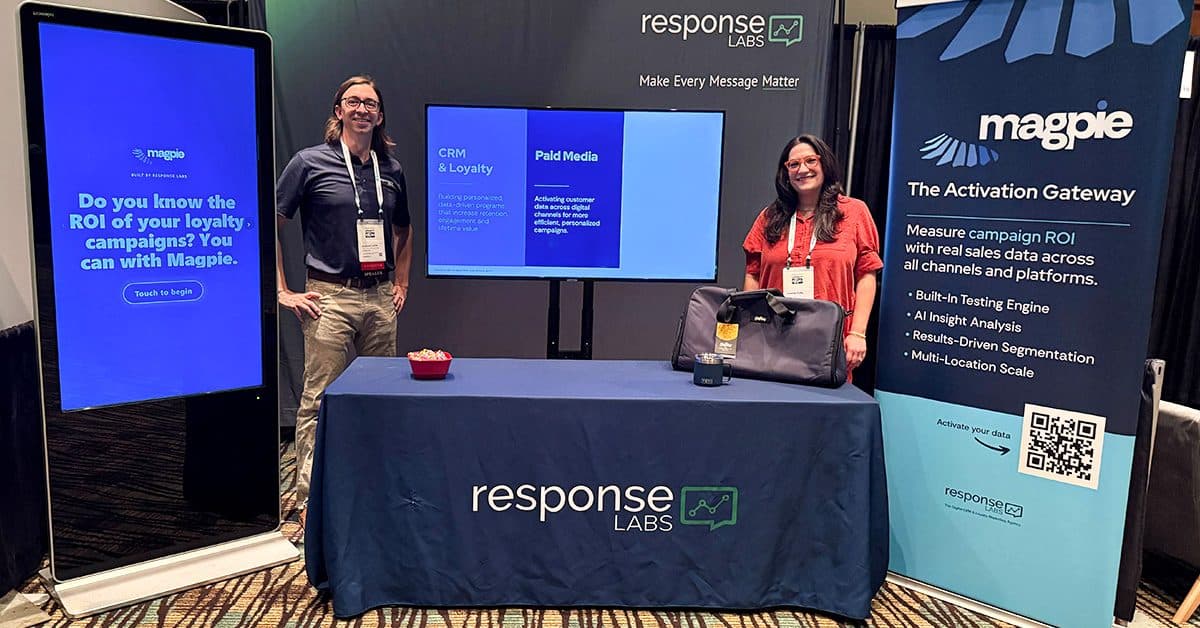
Thanks to Loyalty360 for having me. If any of this hit close to home, I'd like to hear about it, so reach out and let's talk through where your program stands.