Data & Analytics
How to Select the Right Customer Data Platform for Your Business
Response Labs
November 3, 2026 · 7 minutes

A practical framework for choosing a customer data platform (CDP) that fits your architecture, operating model, and growth priorities.
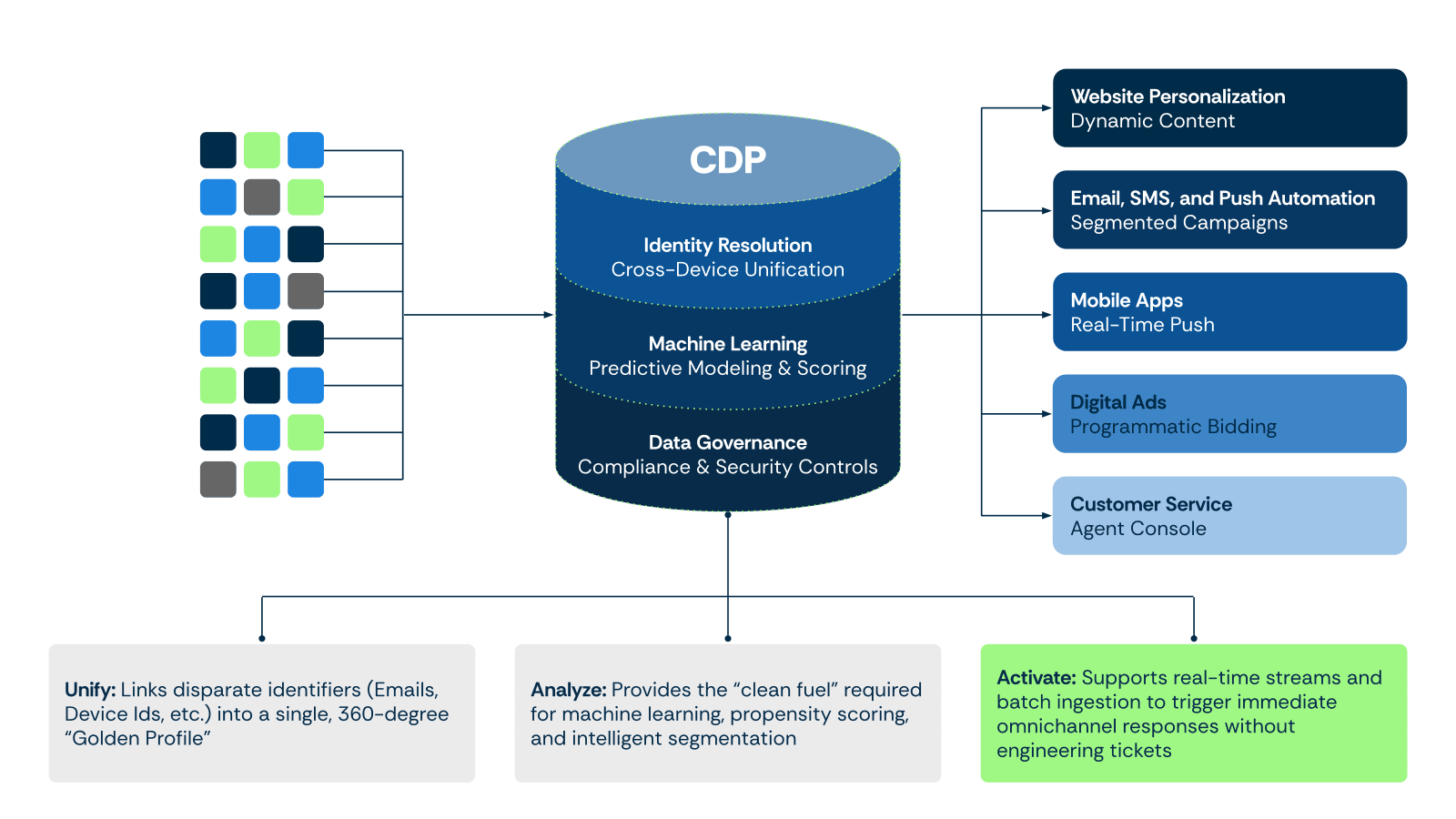
Customer data platforms promise one connected view of the customer that can power more relevant experiences across channels. However, selecting a CDP is not simply a feature comparison, it is an architectural and operational decision that can shape how your organization manages data for years.
The market includes packaged platforms, warehouse-native tools, and hybrid approaches. Each can be the right answer. The challenge is finding the model that best supports your existing data foundation, business priorities, and day-to-day users.
Start with the job the CDP needs to do
Before evaluating vendors, align on the role a CDP should play. At its core, the platform should connect four capabilities.
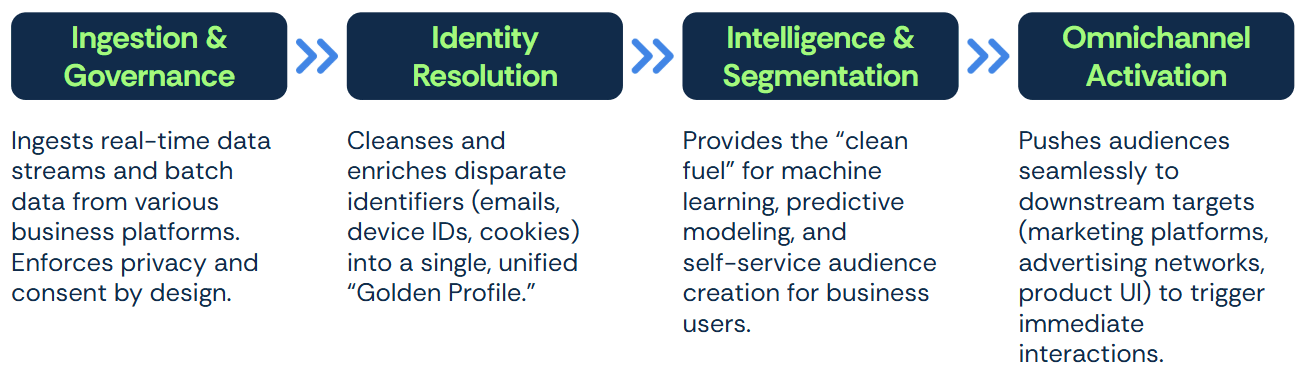
- Ingestion and Governance: Bring together customer data while applying privacy, consent, and security rules.
- Identity Resolution: Connect disparate identifiers into a usable unique customer profile, often called the "golden profile."
- Intelligence and Segmentation: Create reliable audiences and a clean foundation for analytics and personalization.
- Omnichannel Activation: Send audiences and signals to marketing, advertising, product, and service channels.
Organizations will place different weights on each capability. A company focused on media efficiency may prioritize activation, while a loyalty-driven business may need stronger identity resolution. A complex organization may care most about permissions and governance. Start with ranked use cases, measurable outcomes, and operating constraints - not a vendor shortlist.
Choose the architecture before the logo
One of the most important choices is where customer data will live and which system will remain the source of truth.
- Packaged CDPs typically ingest and manage data within the vendor's environment. They can offer a unified interface and tight ecosystem integration, but may introduce data duplication, migration complexity, and greater dependence on one vendor's roadmap.
- Composable CDPs generally work with an existing cloud data warehouse, using it as the source of truth and activating data into downstream tools, without moving the data into the vendor's environment (often called "zero-copy"). This can improve control, flexibility, and speed when the data foundation is mature, but it also places more responsibility on the organization's data model, governance processes, and internal teams.
- Hybrid approaches combine elements of both. Whatever the label, determine which functions truly operate against existing data, which require data to be copied, and how identity, segmentation, and activation work in practice.
Comparison of CDP infrastructure
| Traditional | Composable | |
|---|---|---|
| Data Storage | Managed in a proprietary, "black box" silo. Requires heavy data duplication and syncing. | Leverages your existing Data Warehouse as the source of truth. |
| Data Control | Vendor controls schema and data lifecycle. High risk of long-term vendor lock-in. | "Zero-copy" architecture. You retain full control; activate data without moving it. |
| Implementation | Heavy, months-long lift to migrate data into the vendor's platform. | Faster time-to-value. Plugs seamlessly into your current cloud infrastructure. |
| Flexibility | Rigid. You are tied to the vendor's specific tools, UI, and roadmap. | Modular. Swap out ingestion or activation tools without rebuilding the foundation. |
| Pricing Model | High fixed licensing fees or priced by total profiles stored. | Consumption-based. Scales predictably with actual sync usage and warehouse costs. |
Evaluate how the platform will operate
A platform can look ideal in a diagram and still create friction in daily use. Examine where data is stored, who controls the schema, how transparent identity-matching rules are, and how easily data can move elsewhere. Then consider activation: can teams move from insight to experience without recurring engineering support, and how well does the platform connect to the systems already central to the business?
Usability matters as much as technical capability. Determine whether marketers and analysts can complete common tasks confidently or whether the platform will remain dependent on specialists. Governance must also scale across permissions, business units, regions, and channel-level consent.
Finally, model the true cost of growth. Pricing may be based on profiles, storage, events, queries, transformations, data movement, destinations, or active syncs. Include implementation, specialist resources, training, and ongoing governance, and estimate what happens when more teams, data, and use cases are added. The goal is to understand not only what the platform costs to launch, but what it costs when the program succeeds.
1. The Data Model Is King
Spend time validating your data model before implementation. A comprehensive understanding of all inputs, transformations (ETL/ELT), and expected outputs is fundamental to preventing "garbage in, garbage out."
2. Cross-Functional Buy-In
A CDP impacts Product, Marketing, Advertising, Compliance, and IT. It cannot be siloed. All teams must be involved early to align on security standards and operational use cases.
3. Cost Of Complexity
Understand the underlying operations required. Do you require additional licenses for multi-brand data stores? Will you be charged a "tax" for every ETL query and data transfer?
4. Privacy By Design
The CDP acts as the primary enforcement point for governance. Ensure the platform seamlessly handles tightening consent regulations (CCPA and other US state regulations, GDPR, etc.) across all unified profiles.
Implementation success begins before implementation
No CDP can compensate for an unclear data model or fragmented ownership. Document sources, identifiers, transformations, refresh patterns, quality issues, and required outputs before selecting a platform. Align marketing, data, technology, product, legal, and privacy teams on what a unified profile means and how consent will be enforced.
The operating model is equally important. Define who creates audiences, approves data use, monitors quality, manages integrations, troubleshoots issues, and measures impact. When testing finalists, use your own data and representative workflows - including edge cases - rather than relying only on a polished demonstration. Then build a three- to five-year view of cost and capability before making the final decision.
Regardless of vendor decision, a successful deployment requires rigorous upfront planning. You will be locked into your CDP architecture for years to come.
The right CDP is the one you can use well
There is no universally best customer data platform. The right choice depends on the maturity of your data foundation, the value of ecosystem integration, your tolerance for vendor dependence, your internal capabilities, the experiences you want to deliver, and the overall anticipated cost.
The strongest organizations begin with strategy, make the architectural trade-offs explicit, and pressure-test how the platform will operate at scale. That turns CDP selection from a technology purchase into what it should be: a durable customer data decision.
Frequently Asked Questions
- What is a customer data platform (CDP)?
- A customer data platform brings customer data together into one connected view that can power more relevant experiences across channels. At its core it connects four capabilities: ingestion and governance, identity resolution, intelligence and segmentation, and omnichannel activation.
- What is the difference between a packaged CDP and a composable CDP?
- A packaged CDP ingests and manages data inside the vendor's environment, offering a unified interface and tight ecosystem integration but often requiring data duplication and greater dependence on one vendor. A composable CDP works with your existing cloud data warehouse as the source of truth and activates data into downstream tools without moving it, which improves control and flexibility but puts more responsibility on your own data model, governance, and teams.
- What does zero-copy mean for a CDP?
- Zero-copy describes a CDP that activates customer data directly from your existing data warehouse instead of copying it into the vendor's environment. The warehouse stays the source of truth, and you retain control of the schema and data lifecycle.
- How should I start a CDP evaluation?
- Start with ranked use cases, measurable outcomes, and operating constraints rather than a vendor shortlist. Decide which of the four core capabilities matters most to your business, then choose an architecture, because where customer data lives and which system is the source of truth shapes everything that follows.
- How are customer data platforms priced?
- Pricing may be based on profiles, storage, events, queries, transformations, data movement, destinations, or active syncs. Packaged platforms often carry high fixed licensing fees or price by profiles stored, while composable platforms are typically consumption-based. Model implementation, specialist resources, training, and governance too, and estimate the cost as more teams, data, and use cases are added.
- What should I do before implementing a CDP?
- Document data sources, identifiers, transformations, refresh patterns, quality issues, and required outputs. Align marketing, data, technology, product, legal, and privacy teams on what a unified profile means and how consent will be enforced, and define who creates audiences, approves data use, and monitors quality. Test finalists with your own data and representative workflows, including edge cases.
- Which customer data platform is best?
- There is no universally best CDP. The right choice depends on the maturity of your data foundation, the value of ecosystem integration, your tolerance for vendor dependence, your internal capabilities, the experiences you want to deliver, and the overall anticipated cost.