Salesforce
Mapping the Future of Salesforce Marketing Cloud and Braze

Technical implications, platform shifts, and future-state capabilities following the $5.66B acquisition
From an enterprise architecture perspective, Salesforce's planned $5.66 billion acquisition of Braze is more than a typical portfolio expansion. Valued at more than double the $2.5 billion paid for ExactTarget in 2013, the transaction reveals a fundamental reality: traditional CRM marketing engines were never designed to process sub-second, real-time behavioral signals. For solution architects and martech practitioners building in Marketing Cloud Engagement (MCE), this move signals a necessary evolution from batch-oriented CRM messaging toward stream processing and composable data activation.
1. The Architectural Divide: Relational CRM vs. Event Streaming
To understand why this acquisition makes sense, we must compare the underlying frameworks of the two platforms.
Marketing Cloud Engagement (MCE) has long served as the enterprise standard for complex relational data models, SQL-driven Automation Studio activities, and structured email journeys tied back to CRM records. However, its relational Data Extension model and polling-based scheduling struggle with more immediate mobile interactions.
On the other hand, Braze was built around cloud-native event streaming. By capturing real-time behavioral signals directly through mobile and web SDKs, Braze evaluates triggers in milliseconds across all messaging channels. Furthermore, its composable data architecture can query cloud data warehouses like Snowflake and Databricks without forcing companies to duplicate storage, allowing organizations to decouple compute and data storage from campaign execution.
2. Core Modernization and the Consumer Activation Gap
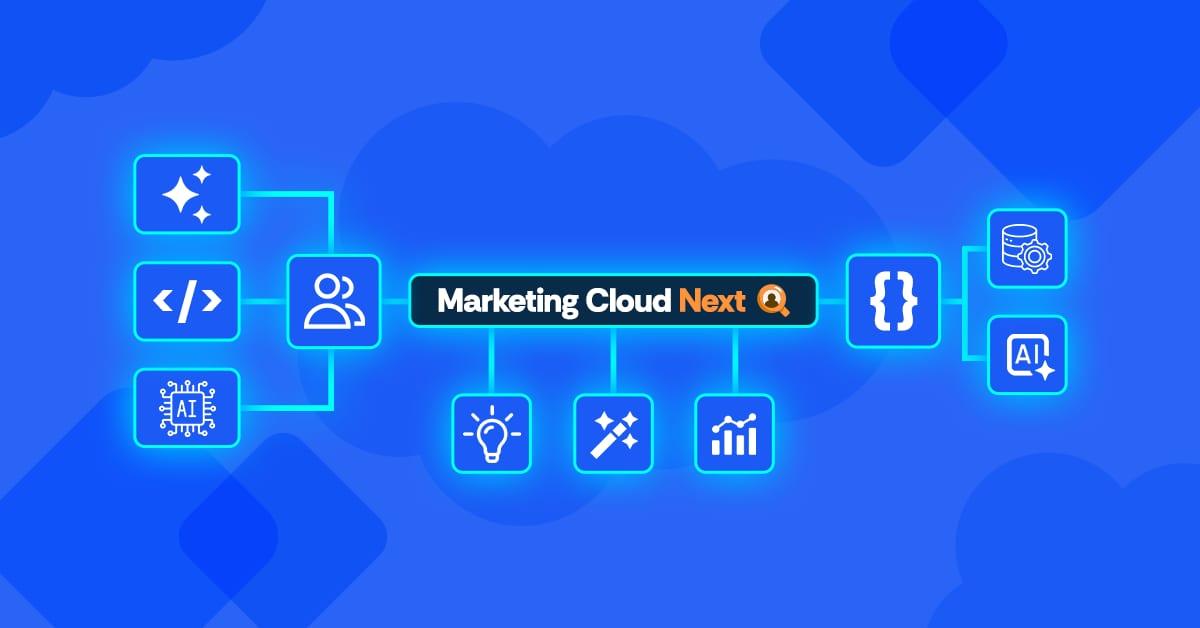
Salesforce attempted to modernize its marketing stack natively with Marketing Cloud Next (MCN), re-platforming marketing automation onto core architecture using Flow Builder, Data 360, and Agentforce. While MCN successfully ties together marketing workflows with standard Salesforce objects and enterprise AI agents, scaling core CRM infrastructure to process billions of high-frequency consumer app actions remains an immense challenge. By acquiring Braze, Salesforce is getting a battle-tested consumer activation engine instead of having to spend years attempting to re-engineer its own.
3. Three Architectural Integration Scenarios
How will Salesforce ultimately integrate Braze, considering its portfolio of marketing automation tools? Looking ahead, here are three possible scenarios:
Scenario A: The Divide - B2C Event Activation vs. B2B Lifecycle Orchestration
Under this workload-split scenario, Salesforce establishes a clean boundary between consumer and business use cases. Braze becomes the primary B2C activation engine, managing high-volume mobile push, in-app experiences, and real-time behavioral loops.
Concurrently, Marketing Cloud Next assumes the B2B marketing automation role historically occupied by Account Engagement (Pardot), focusing on lead scoring, pipeline attribution, and multi-tier account journeys deeply coupled with Sales and Service Cloud. This separation prevents platform bloat by assigning high-concurrency event workloads to Braze and leaving relational CRM orchestration with MCN.
Scenario B: The Warehouse-First Composable Route - An Alternative to Forced Data 360 Adoption
This scenario addresses a critical point of friction for enterprise martech architects and prospective Salesforce users. Today, many brands already maintain their single source of customer truth in external cloud data warehouses like Snowflake or Databricks. When evaluating Marketing Cloud Next, these clients frequently resist being forced into purchasing and implementing Data 360 just to activate customer data. If a brand isn't using other clouds in Customer 360, adopting Data 360 can be a challenging case to make.
Because Braze natively queries Snowflake and Databricks without requiring data ingestion or duplication, Salesforce can offer a pragmatic choice: clients can build on Data 360 if they want native core alignment, or use Braze directly on top of their existing data warehouse. As long as Salesforce preserves Braze's composable, warehouse-agnostic foundation, it can both attract enterprise messaging clients and keep less well-adopted accounts from abandoning the ecosystem entirely.
Scenario C: The Hybrid Migration Path - Coexistence Preceding Legacy MCE Retirement
A third scenario outlines the long-term migration path for existing Marketing Cloud Engagement customers. Enterprise marketing systems are rarely rip-and-replace, and Salesforce will likely deploy surface-level integrations first (bridging Flow Builder and Data 360 audiences into Braze Canvas, similar to its initial hooks with Datorama and other past acquisitions).
Over time, however, rather than forcing MCE customers through an uphill migration onto core MCN architecture, Salesforce could deliver schema-mapping utilities that translate MCE Data Extensions and Journey Builder decision splits directly into Braze Canvas. This provides legacy MCE clients a modernized, cloud-native destination that preserves their implementation under the Salesforce contract umbrella - a smooth offramp from MCE with a more reasonable level of investment.
4. Architectural Recommendations for Enterprise Martech Teams
For enterprise architects and martech leads, one thing is clear: do not initiate preemptive system refactoring. With the closing of the deal not happening until FY2028, and a lot of unanswered questions about the future, both platforms will operate independently for some time. The immediate technical imperative is data hygiene and documentation:
- Audit Event Workloads: Catalog which existing customer journeys rely on batch relational queries versus live event triggers and mobile interactions. Know your data sources and triggers.
- Consolidate Identity Resolution: Resolve identity discrepancies upstream between Salesforce CRM and external cloud data warehouses (Snowflake, Databricks). Getting ahead on creating the rules and repercussions of this process is very important.
- Map Composable Potential: Evaluate data costs and determine which behavioral datasets should live in data warehouses versus customer profile data stores.
- Pay Attention To Your Contracts: When negotiating upcoming Salesforce or Braze renewals, prioritize one-year contract terms or include license-swap / migration clauses. There will undoubtedly be periods of overlap, so flexibility is key.
Ultimately, an activation and messaging engine is only as effective as the data beneath it. Organizations that prioritize identity, hygiene, and journey mapping now will be best positioned to capitalize on whichever integration architecture and options Salesforce ultimately settles on.
Frequently Asked Questions
- Why is Salesforce acquiring Braze?
- Salesforce's traditional CRM marketing engines were built for batch, relational messaging, not for processing sub-second, real-time behavioral signals from mobile and web apps. Braze was built around cloud-native event streaming, so acquiring it gives Salesforce a proven consumer activation engine instead of spending years re-engineering its own core infrastructure to handle billions of high-frequency app events.
- How much is Salesforce paying for Braze?
- Salesforce announced a definitive agreement to acquire Braze for approximately $5.66 billion in October 2026. That is more than double the $2.5 billion Salesforce paid for ExactTarget, the platform that became Marketing Cloud, in 2013.
- What is the difference between Marketing Cloud Engagement and Braze?
- Marketing Cloud Engagement (MCE) is built on a relational Data Extension model with SQL-driven Automation Studio activities and polling-based scheduling, which suits complex data models and structured email journeys tied to CRM records. Braze captures real-time behavioral signals through mobile and web SDKs, evaluates triggers in milliseconds across channels, and can query cloud data warehouses like Snowflake and Databricks without duplicating data.
- Will Braze replace Marketing Cloud Engagement?
- Salesforce has not announced a plan, and the deal is not expected to close until FY2028. One plausible path is coexistence first, with surface-level integrations, followed by tools that translate MCE Data Extensions and Journey Builder logic into Braze Canvas, giving MCE customers a modernized destination without a full migration onto Marketing Cloud Next.
- Will I need Data 360 to use Braze after the acquisition?
- Not necessarily. Braze natively queries Snowflake and Databricks without requiring data ingestion or duplication. If Salesforce preserves that composable, warehouse-agnostic foundation, brands could choose Data 360 for native core alignment or run Braze directly on their existing data warehouse.
- What should Marketing Cloud customers do about the Braze acquisition right now?
- Avoid preemptive system refactoring, since both platforms will operate independently for some time. Focus on data hygiene and documentation: audit which journeys rely on batch queries versus live event triggers, resolve identity discrepancies between Salesforce CRM and your data warehouse, map which datasets belong in the warehouse, and favor one-year terms or license-swap clauses on upcoming renewals.